


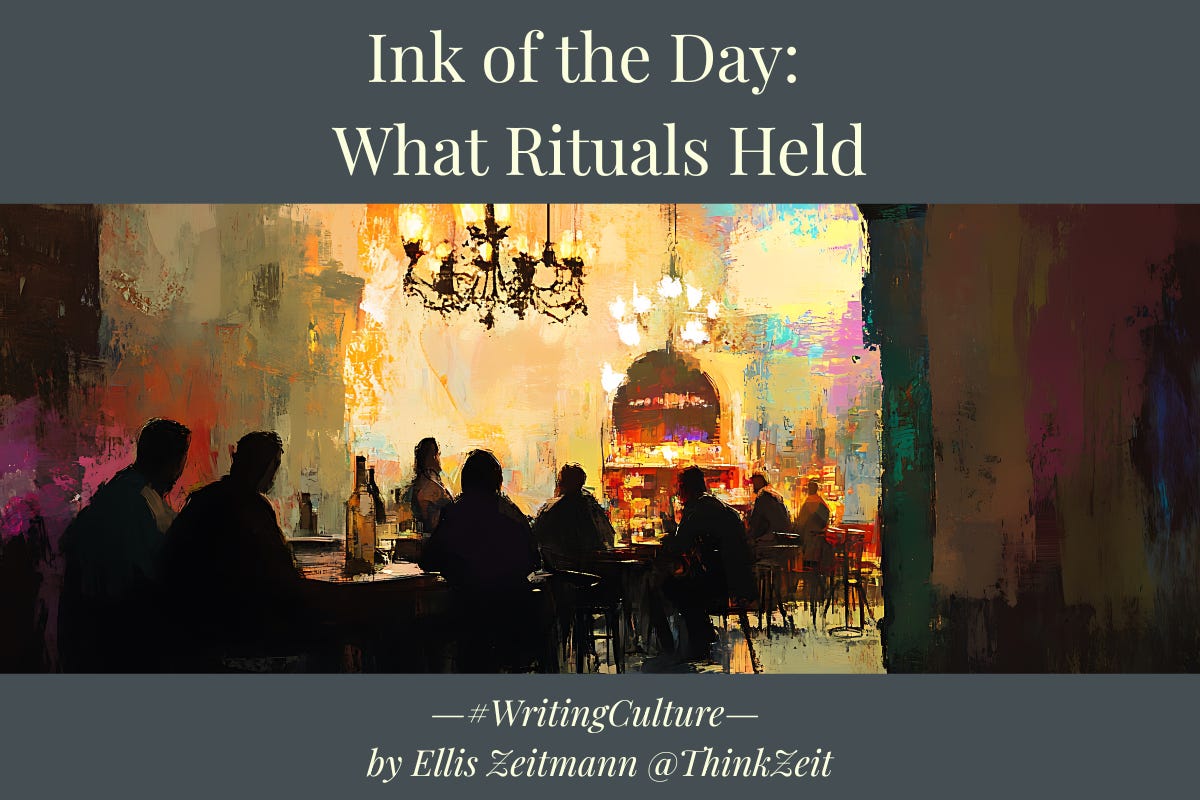
I keep thinking about happy hour as if it were a place, but it was never a location. It was a permission. A narrow interval where no one had to arrive complete. You could be unsure, junior, awkward, not yet formed, and still belong without explanation. Right now, writing “permission,” I feel how gently I am treating that memory, how the softness of the word itself accomplishes the rescue I claim to be scrutinizing.
What I miss is not the drinks or the jokes, but the way uncertainty had somewhere to go. Happy hour absorbed it. The dim light, the background noise, the loose geometry of standing bodies allowed doubt to circulate without turning inward. You did not need to succeed socially. You only needed to remain present long enough for the feeling to pass through you and into the room. But notice what I am doing: I call it “absorption” as if I have graduated from needing it, as if clinical distance spares me from recognizing that analyzing the ritual might be my current ritual, a way to process the absence without inhabiting it.
Now that container is gone. The workday ends cleanly. Everyone goes home. The same uncertainty still arrives, but without witnesses. I notice how quickly it calcifies into something private. If I feel isolated, I assume I failed. If I do not find a mentor, I conclude I am uninteresting. The doubt remains unchanged, but without a shared interval to hold it, doubt begins to feel diagnostic. And here, writing this, I catch myself making the absence structural rather than intimate, because making it structural is how I avoid confronting what I actually feel. The sophisticated awareness that “this is systemic, not individual” might be the most individual defense of all.
What unsettles me is not that happy hour disappeared, but how readily I transform its absence into evidence about myself. I call it “social anesthesia” as if that phrase explains something, but the explanation is what I am displaying, not what I am experiencing. Even this sentence, attempting to catch that movement, enacts it. I mistake the display for genuine inquiry, and the inquiry becomes another performance of having understood. The acknowledgment that I perform understanding is itself a performance, and there is no position outside this loop from which to observe it cleanly.
If I want the ritual back, perhaps I want it to do again what it always did: soften private doubt just enough to make it ambient, like voices heard through walls, to turn isolation into background noise so I do not have to face how quickly I translate shared conditions into verdicts about myself. But claiming I want this is already the move. It stages me as someone aware enough to see the pattern, so I am not the problem, so the insight rescues me from the very thing it describes.
If loneliness feels sharper without happy hour, what if the claim that we are carrying alone what once belonged to a room is itself the anesthesia? The structural explanation might be how we avoid noticing that even sophisticated awareness of systemic absence can function as refusal to feel what we feel. And recognizing this refusal does not escape it. The recognition becomes what we perform instead. Even now, writing this final reversal, I feel how satisfying it is to arrive at this insight, how the satisfaction itself might be what I am unwilling to examine.
—#WritingCulture— by Ellis Zeitmann @ ThinkZeit.
#WritingCulture #InkOfTheDay #The Performed Self #ExistentialThinking #GoingOnBeing #PhilosophyOfLife #Identity #SelfReflection #PerformedSelf #CulturalCapital #Becoming