


I write about the performance of happiness as someone who has maintained gratitude journals, curated joyful moments for social media, and tracked my emotional states as if optimization could stabilize what keeps slipping away. But notice how even this confession stages enlightened distance from naive pursuit, the meta-position that proves I’ve transcended the staging by recognizing it. The vision board I created last January testifies not to what I’ve achieved but to who I’ve constructed myself to be: someone oriented toward happiness, someone for whom joy registers as identity rather than experience, someone whose emotional state is a credential to be earned and displayed. Right now, composing this sentence, I calculate whether mentioning the vision board makes me seem self-aware or deluded, whether my relationship to contentment is genuine or simply another display for the audience that is me watching me pursue it.
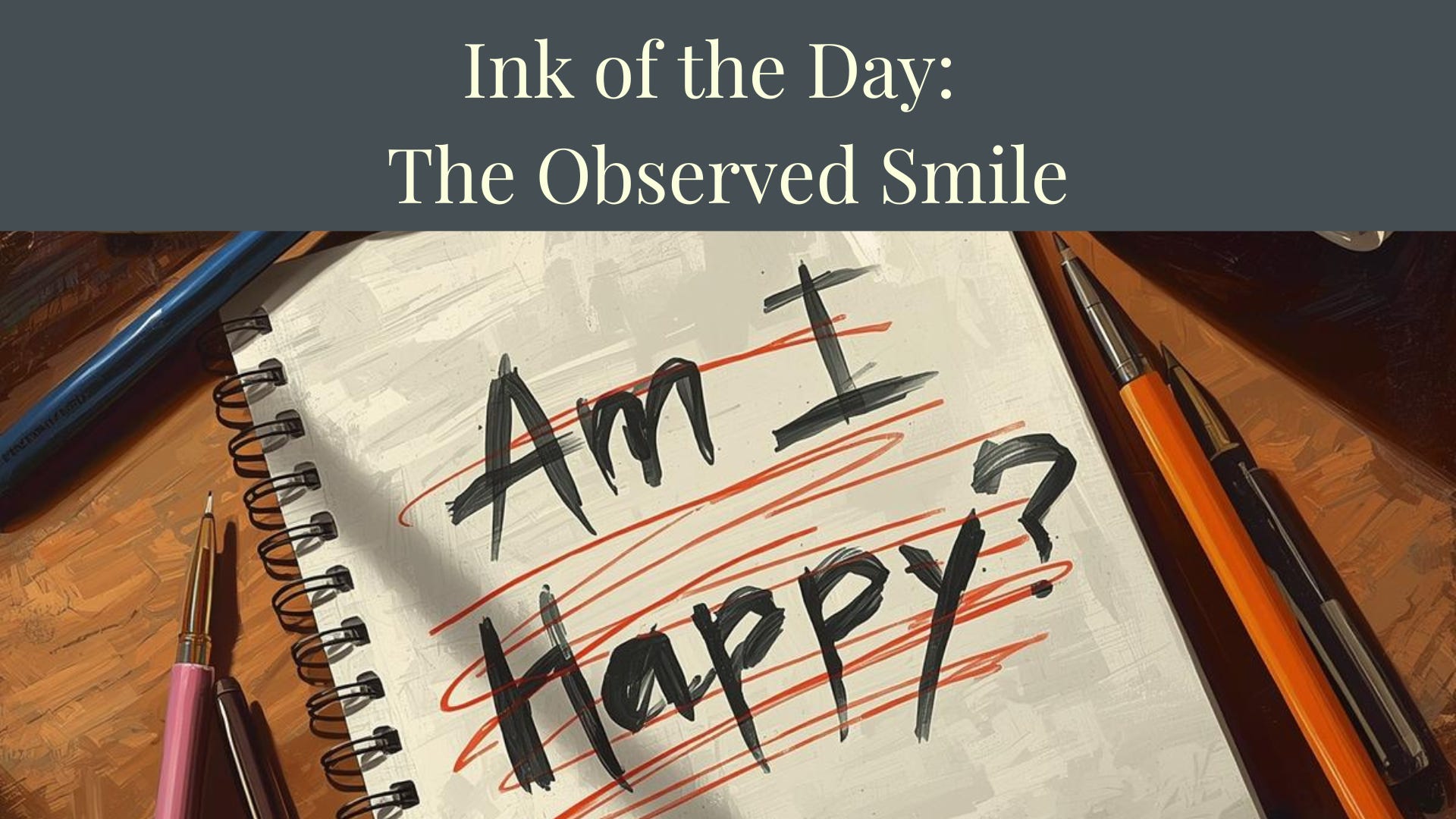
The staging infrastructure reveals itself in what we choose to display and measure. The gratitude journal entry written not for myself but for the imagined reader who will judge whether I’ve learned to appreciate enough. The photograph taken at the supposedly joyful moment, the camera raised to capture proof that I was here, that I felt this, that the happiness happened and can be verified. The wellness apps that track my mood as if emotions were data points to be optimized, each logged entry a performance of someone taking their happiness seriously. But the infrastructure operates whether I track formally or not. The internal question, Am I happy?, runs constantly whether logged in an app or not, the surveillance apparatus generating the emotional state it pretends to measure. The person who dismisses gratitude journals still narrates contentment to themselves, still converts feeling into proof, still performs happiness in the micro-calculations of daily existence: the forced smile to prove the dinner was enjoyed, the mental note that yes, I appreciated that sunset, the small satisfaction of feeling satisfied. I perform contentment in response to “How are you?” before the question fully registers, the automatic “Good!” staging psychological health for an audience I cannot identify. The vision board itself is curated for a watcher, not future me, but the internalized judge who measures whether I’m oriented correctly toward contentment, whether my desires are acceptable, whether I’ve demonstrated sufficient commitment to the mandatory pursuit that proves I’m succeeding at life.
The voice that asks Are you happy? is older than any vision board or gratitude practice. It arrives before adolescence, installed by the parental gaze that measured its own adequacy through my affect, that taught me my emotional state is not private experience but public performance, proof of their success as caretakers. The child who learns that parental anxiety is soothed by displays of joy discovers early that happiness is currency, that to exist as valued I must demonstrate contentment. This is not personal failing but structural installation. The apparatus that narrates emotional states into existence cannot observe those states without claiming them, and claiming them transforms raw experience into performance. When I ask myself whether I’m content, I do not encounter genuine affect. I encounter the surveillance mechanism that has been generating “genuine affect” since before I had the vocabulary to question it. What I think I’m pursuing is the stage on which this ancient watcher enacts its oldest trick: watching myself feel, converting feeling into credential, each emotional state immediately colonized by the narrator who describes it to prove someone is experiencing it.
But here is what pursuing contentment reveals if I let myself see it: there is a microsecond between affect and the voice that narrates it. A gap so brief I leap across it immediately, retroactively narrating the emotion to prove I experienced it. In that gap, before I am happy arrives, before this is joy asserts itself, something happens that has no witness narrating it into existence. It is not bliss. It is not satisfaction. It is not anything I can verify, which is precisely why the narrating voice rushes in to name it, to claim it, to convert it into proof. And the instant I attempt to stay in that gap, to preserve that pre-reflective state, I have already left it. The attempt to remain is itself observation, the preservation already performance. What disturbs me is not that the feeling is elusive. What disturbs me is discovering that the instant I notice I’m happy, I’m no longer in it. I’m in the watching of it, the staging of someone experiencing it, already calculating how to describe this to myself as evidence that the pursuit succeeded. And there is no category called “genuine happiness” that escapes this collapse. The distinction between genuine and performed exists only in retrospect, as another narration that sorts experiences into authentic and inauthentic, each sorting itself a performance of someone sophisticated enough to tell the difference. The feeling I call genuine is simply the one where I haven’t yet caught myself performing. It is not failing when it fades. It is failing when I get close enough to claim it, when I realize that what I call contentment is the mechanism I built to never have to encounter the gap where affect exists without someone staging it. The watching does not reveal satisfaction. It reveals the emergency protocol that generates the claim to avoid the unbearable instant before anyone is there to feel it.
Even writing this analysis, I enact it. I arrange these sentences to demonstrate that I have seen through the staging, as if seeing through it grants me access to something more real than the display itself. But notice what happens: the critique becomes another credential, another proof that I’ve achieved the sophisticated stance that recognizes contentment as construction. Right now, writing about the collapse of claimed feeling, I am watching the watching, and some part of me registers the small satisfaction of having articulated this recursion precisely, which is itself a claim to intellectual fulfillment, another emotional state immediately colonized by the narrator who converts it into proof. I cannot describe the gap where affect might exist without the description covering the gap. I cannot point to pre-reflective affect without reflection arriving to claim it retrospectively. The person who writes about this staging enacts the most refined version, the one that earns recognition precisely by claiming to have abandoned the pursuit of recognition, the critique that is the commodity, the analysis that becomes the achievement I can feel satisfied about achieving.
If I stopped staging the pursuit, if I allowed myself to exist without tracking satisfaction or listing gratitude or asking whether I’m content, would anything remain? But notice what happens when I decide to stop: the decision itself becomes evidence of sophistication, proof that I’ve transcended the need for proof. I perform not-performing. The cessation becomes the credential. Not the authentic state I imagine beneath the display. That feeling is already a construction, already a story about what contentment should feel like if I finally achieved it. What remains in the gap before the narrator arrives to claim the emotional state? I do not know because the instant I approach it, I am already constructing the approach, already watching myself observe, already converting raw affect into proof that I am someone capable of feeling. Perhaps what I defend with all this staged pursuit is not contentment but the unbearable recognition that there is nothing to defend, that emotional states exist only as claims narrated into existence. And this mechanism operates on whatever I substitute for happiness: meaning, purpose, contentment, peace, fulfillment. Each becomes another emotional state to pursue, observe, claim, convert into proof. Consciousness without the surveillance apparatus generating affect is not contentment but vertigo, not satisfaction but the void where no state can be authentic because there is no one there to experience it. The pursuit does not fail because I cannot find what I seek. The pursuit fails because what I claim, once claimed, is already staging, and the thing I call “I” is simply what I have named the unbearable interval between feeling and the voice that rushes in to say I feel this, converting experience into credential, existence into display.
Writing about the staging produces the display of having transcended it, as if the analysis itself is not another pursuit of the intellectual satisfaction I can claim as achievement. I will seek contentment tomorrow and the whole apparatus runs again: the morning gratitude ritual, the mood tracking, the internal question Am I happy?, the voice that narrates whatever answer arrives, the watcher of the watcher, the essay I might write about watching the watcher. Each layer professes to be closer to authentic affect, something finally free of construction. But perhaps the freedom I seek is not beneath the watching. Perhaps it is the recognition that there is no beneath, that all the way down it is staging and narration, and the thing I name as fulfillment is simply what I have called the unbearable interval between affect and the voice that claims it. The pursuit does not end. The watching does not stop. And the question that follows me from the vision board to the gratitude journal to every moment that claims satisfaction is the same question that greets me in the supposed refuge itself: if emotional states are surveillance all the way down, what exactly am I trying to feel?
For every moment photographed to prove it was joyful, every feeling tracked to verify it was felt, and for all who have pursued happiness while discovering that observation collapses the observed, and that the question Am I happy? is the mechanism that ensures we never are.
#WritingCulture #InkOfTheDay #PerformedSelf #ExistentialThinking #GoingOnBeing #PhilosophyOfLife #Identity #SelfReflection #CulturalCapital #Becoming