


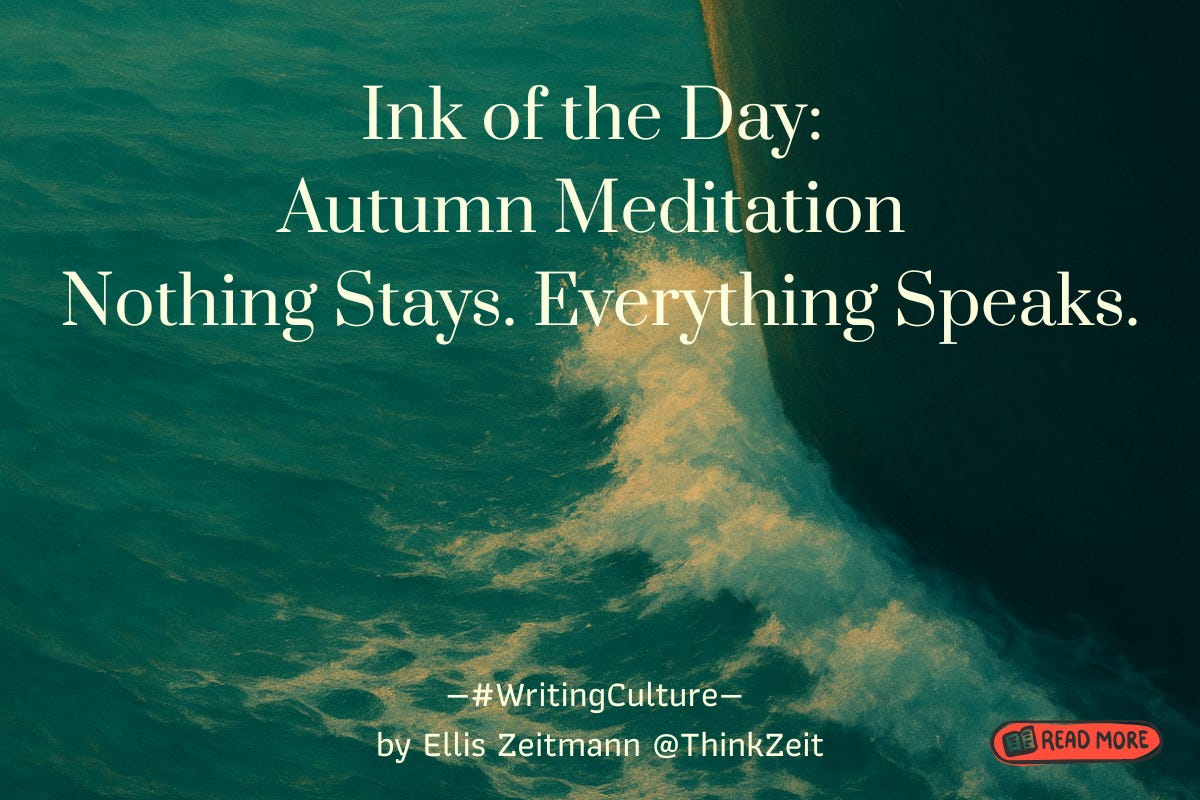
Position: 11°20.64′ N, 058°38.79′ E. I watch water drain past the hull, each molecule replaced before I can register its passing. Nothing accumulates. Nothing stays. The observation arrives with unusual clarity, and then I notice what follows it: I am thinking about graveyards.
This is the season when others gather at monuments, when absence gets organized into rows, when the dead receive their scheduled remembrance. I am here instead, watching water that demonstrates impermanence more honestly than any carved stone. The ocean performs no grief. It simply continues, indifferent to what passes through it.
Except I feel guilt about this. Should I be there? The question surprises me with its insistence. I have spent years telling myself I chose this life precisely to escape such rituals, to live with actual transience rather than visiting structured versions of it once annually. Yet here is guilt, uninvited, suggesting I am missing something that matters, or that I should feel I am missing something that matters, or that my comfort with missing it reveals something I would prefer not to see.
I catch myself constructing justification in real time. Look, I think, nothing stays anyway. The hull parts water that immediately closes behind us, no trace, no monument possible. Isn’t this the more authentic relationship with loss? The carved stone pretends something can be held, maintained, visited on schedule. The ocean admits what the graveyard conceals: nothing accumulates, everything passes, permanence is the lie we organize into rows.
But even as I construct this defense, I recognize its architecture. I am building my own monument right now, more sophisticated than granite, more eloquent than inscription. The sailor who transcended cultural ritual through genuine encounter with transience. The man who chose isolation not as escape but as the only honest response to impermanence. My absence becomes proof of depth. My years at sea become credentials. The guilt gets metabolized into awareness that I have seen through what others still require.
What if both are theater? The graveyard visitor enacting proper grief on schedule, demonstrating feeling at socially appropriate intervals, yes. But also me, performing liberation from performance, using years of maritime solitude as evidence that I have moved beyond what others still need. The water keeps moving past, utterly indifferent to my interpretation of its movement as teaching me anything.
The graveyard arranges death into manageable form: here lies someone, dates provided, tribute carved in stone that will itself eventually erode. We call this remembrance, but watch how it functions. It gives grief a location, a schedule, an acceptable duration. It transforms the unbearable into the commemorable. The violence is so refined we mistake it for reverence.
And what am I doing differently? I frame my absence from ritual as meaning. I transform not participating into participation of a higher order. I write about water that won’t stay as if the writing isn’t itself an attempt to make it stay, to turn constant replacement into insight I can hold. Right now, composing this sentence, I am constructing the monument I claim to have transcended. The guilt becomes material for reflection. The ocean becomes teacher. The absence becomes presence of a more sophisticated kind.
Both become ways of holding loss at precisely the distance I can metabolize it. Neither the gravestone nor the ship’s wake admits the actual unbearable: that those we have lost are simply gone, that no structure makes this tolerable, that our memorials and our criticisms of memorials are equally desperate attempts to make absence into something we can live with.
The water doesn’t pause for my reflection about water not pausing. It continues its constant replacement regardless of whether I interpret this as teaching me detachment or notice myself interpreting it as teaching me detachment or write about noticing myself interpreting it as teaching me detachment. Each level of awareness I add is another stone in the edifice. The performance has no outside.
Perhaps the guilt is simply socialized, proof I still carry the culture I thought I had left behind, residue of a world that insists there are proper ways to hold the dead and I am failing to enact them. Perhaps I should release this guilt the way the hull releases water, let it pass without building elaborate justifications for why I need not feel it.
Or perhaps the guilt is the last honest thing, the signal that resists my years of sophisticated reasoning about why I have transcended the need for what others require. Perhaps it arrives to suggest that my maritime solitude, however genuine, is still a choice about how to hold absence, still a configuration, still a rehearsal I have simply moved to a more isolated stage where fewer people can witness my practice.
I cannot tell which interpretation is depth and which is defense. And immediately I notice this uncertainty feels like wisdom, this admission of not knowing feels like knowing something important. The inability to tell becomes my proof of intellectual honesty, another monument I mistake for truth. I am doing it again.
Reflection
The question I cannot answer, and perhaps the question is unanswerable because any answer would immediately become another display: would I feel this guilt if I hadn’t spent years telling myself I had transcended the need for commemoration? Or is the guilt proof that I haven’t transcended anything, only relocated my theater to a more isolated stage, substituted one kind of ritual for another I find more aesthetically and intellectually defensible?
And framing it as “theater on an isolated stage” sounds like insight, which is to say, sounds like I have understood something, which is to say, I am structuring my inability to escape structure into comfortable self-awareness. The recognition becomes credentials. Even this paragraph, catching myself organizing, is organization. The water continues passing. I continue writing about the water passing. Both are ways of not feeling what refuses arrangement.
Tomorrow the water will keep moving past the hull. I will keep observing this movement while reflecting on my attention while writing what I notice. The layers accumulate even as I write about how nothing accumulates. Perhaps this is all we can do: notice the monuments we build while building them, catch ourselves performing while performing the catching, write about the impossibility of escape while the writing itself demonstrates there is no escape.
Or perhaps even that conclusion, that noticing is all we can do, is the most sophisticated memorial of all, the one that sounds like wisdom because it admits limitation, the one we mistake for transcendence because it acknowledges we cannot transcend. The guilt remains. The water continues. I keep arranging both into sentences I tell myself are honest.
A quiet gratitude to all who have stood at graves this season feeling the inadequacy of any gesture, and to all who have been absent from those gatherings feeling the inadequacy of any justification, discovering that both presence and absence can be elaborate ways of structuring what refuses structure, and that even recognizing this might be the most elaborate configuration of all, the one we mistake for transcendence because it admits we cannot transcend, which is to say, the one that lets us feel wise about our inability to escape the very thing we are doing right now.
—#WritingCulture— by Ellis Zeitmann @ ThinkZeit
#WritingCulture #InkOfTheDay #ExistentialThinking #GoingOnBeing #PhilosophyOfLife