


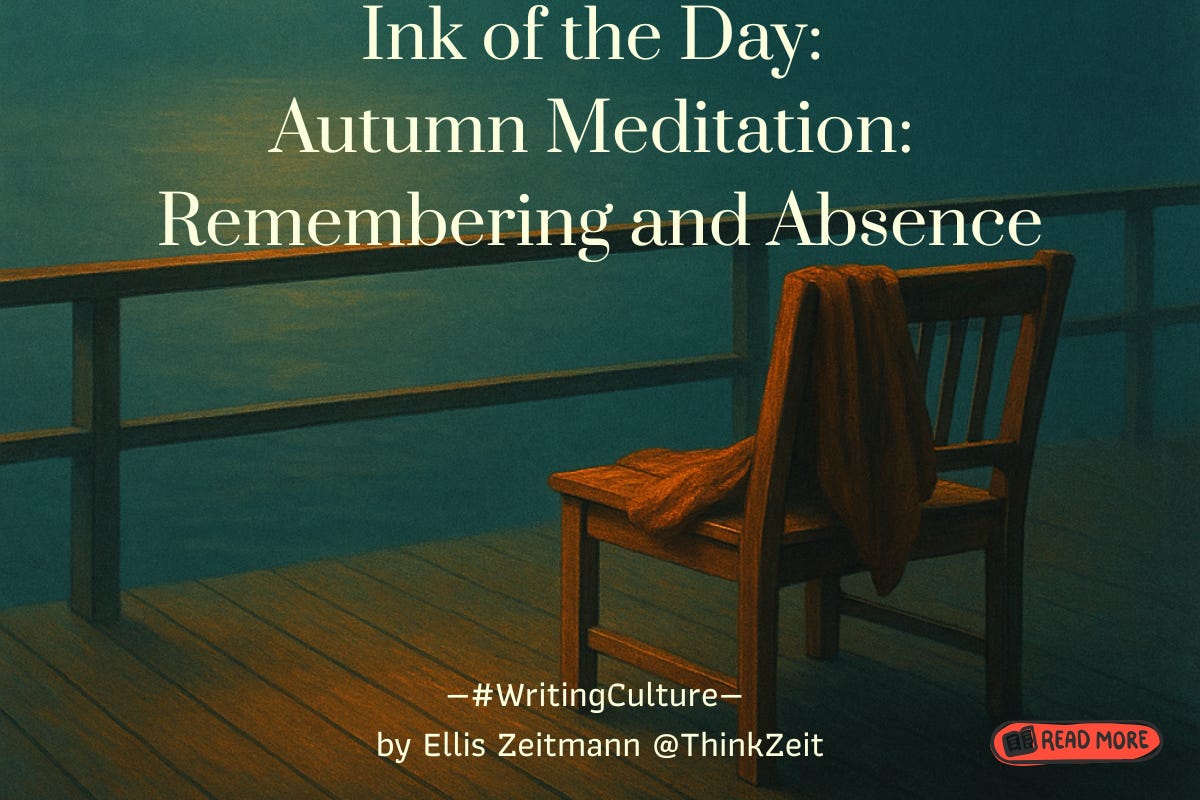
Autumn has always seduced me with its balance between radiance and retreat. The season performs farewell with such grace that one almost forgets it is departure. Yet I realize now that I have mistaken its generosity for reprieve. The warmth of the Indian Summer is not comfort; it is the mind’s last attempt to hold the living image of what is already passing. Each year I tell myself I have learned to let go, but beneath that statement lies a choreography of clinging disguised as acceptance.
Left yesterday morning from Dihamri Marine Protected Area at 12°36.00′ N, 54°11.80′ E, heading east toward the open Indian Ocean. Now at 11°20.64′ N, 58°38.79′ E, following the northeast trade breeze with moderate swell. The sea stretches unbroken, a slow metallic blue under the sun’s unseasonal heat. The air is still warm, yet the wind carries a dry edge. The instruments confirm a subtle shift: barometer falling, water temperature cooling by half a degree. Even in these latitudes, change declares itself through small insistences.
I dive to rinse away the heat, and at once the sea answers. The surface burns against my skin, but below, a cool current moves in from the north. Change itself, arriving without negotiation. My first impulse is to rise again, to keep the warmth a little longer. In that hesitation, I recognize last year’s pattern: the same reluctance, the same illusion of serenity masking fear. But even this recognition feels rehearsed, as if I have learned to perform the insight without actually releasing anything. I notice my pattern of noticing, congratulate myself for seeing my reluctance, and in that congratulation I remain exactly where I was. The dive becomes material for contemplation rather than genuine surrender. I am writing about hesitation while hesitating, turning the cold current into metaphor so I do not have to simply feel it.
Memory arrives with the tide, faces, gestures, words of those I have lost. They return not as grief but as temperature, the warmth I refuse to release. I tell myself I am honoring them, keeping them alive through careful remembrance. But what if I am using memory to avoid the cold emptiness their absence created? The warmth of remembering feels like love, but perhaps it is another hesitation, another refusal to dive fully into the current that moves beneath. To remember too vividly may be to prolong their breath beyond its purpose, not out of devotion but out of my own need to keep something burning. Even now, writing this, I notice how satisfying it feels to articulate the problem so precisely. As if naming my reluctance to let go somehow counts as letting go, as if insight were the same as transformation.
Perhaps this is what Indian Summer truly reveals: we become sophisticated at reheating what should cool. We call it honoring the past when it might be refusing the present. We frame our clinging as mindfulness, our resistance as wisdom. The sea does not do this. It holds, then releases, without narrative, without congratulating itself for releasing well. But I cannot. And here I catch myself again: even framing this as “I cannot let go” creates a comfortable narrative of tragic self-awareness. It lets me perform struggle instead of actually struggling, lets me write beautifully about my limitations while those limitations remain untouched and possibly untouchable. What if there is no letting go because the self that would let go is itself constructed from holding on? What if recognizing this changes nothing because recognition is just another temperature we maintain, another way of staying warm while claiming to understand cold? I float here between surface heat and deep current, writing sentences about my inability to release, and the writing itself becomes the warmth I generate to avoid diving. Even this admission, even catching myself in this loop, produces a small satisfaction, a minor heat. The performance has no outside. There may be no moment when I am not narrating my relationship to warmth, no gesture that escapes becoming material for the contemplation that postpones actual change. Perhaps the Indian Summer never ends because we have learned to carry it internally, to produce endless intervals between what we know and what we do, calling that interval wisdom when it might simply be the last place we can still feel warm.
Reflection
Back on deck, the water has dried from my skin but the questions remain. What relationship, project, or identity am I calling a “transition” when I am actually refusing to end it? Does framing something as a process let me avoid the finality I claim to accept?
When I memorialize someone or something, am I honoring them or using remembrance to avoid feeling what their absence actually means? Can I tell the difference between holding space for grief and simply staying warm?
The sun continues its unseasonal heat. The barometer continues falling. I continue writing about patterns I recognize but cannot escape, and the writing continues to produce its own warmth, its own satisfaction, its own interval between knowing and doing. Perhaps this is all we have: the recognition that recognition changes nothing, performed with enough honesty that the performance almost feels like truth.
A quiet gratitude to the Indian Ocean for showing that even warmth has a current leading elsewhere, and to all who have discovered that our most eloquent descriptions of letting go might be the most sophisticated way of holding on.
—#WritingCulture— by Ellis Zeitmann @ ThinkZeit
#WritingCulture #InkOfTheDay #ExistentialThinking #GoingOnBeing #PhilosophyOfLife